What Are the Best Drawstring Bags for Bulk Buyers in 2026?
For bulk buyers, the best Drawstring Bags in 2026 will be the ones that balance unit cost with durability, useful capacity, and dependable production. Grand View Research valued the global reusable bags market at approximately USD 10.3 billion in 2023 and projected continued growth through 2030. That figure covers many bag types, not drawstring bags alone, but it signals rising commercial interest in reusable carry options. Market growth is not proof that every “eco” claim or low-cost offer is sound.
The practical choice starts with the use case. A school event may need lightweight polyester bags that hold a water bottle and notebook. Retail promotions may call for a heavier fabric, reinforced corners, and a clean print area. For perspective on promotional value, the Advertising Specialty Institute’s Ad Impressions Study compares exposure across branded product categories, including bags. Buyers should still test samples: stitching, cord thickness, fabric feel, and print alignment can vary between bulk runs. Small details matter.
This guide compares material, construction, customization, lead time, and price breaks, while distinguishing published specifications from supplier claims. Request a pre-production sample and confirm the quoted weight, dimensions, packaging, and inspection process in writing. One caution: the lowest price can look convincing on a spreadsheet, yet become costly if cords fray or colors shift. Bulk purchasing rewards careful checks, not assumptions.
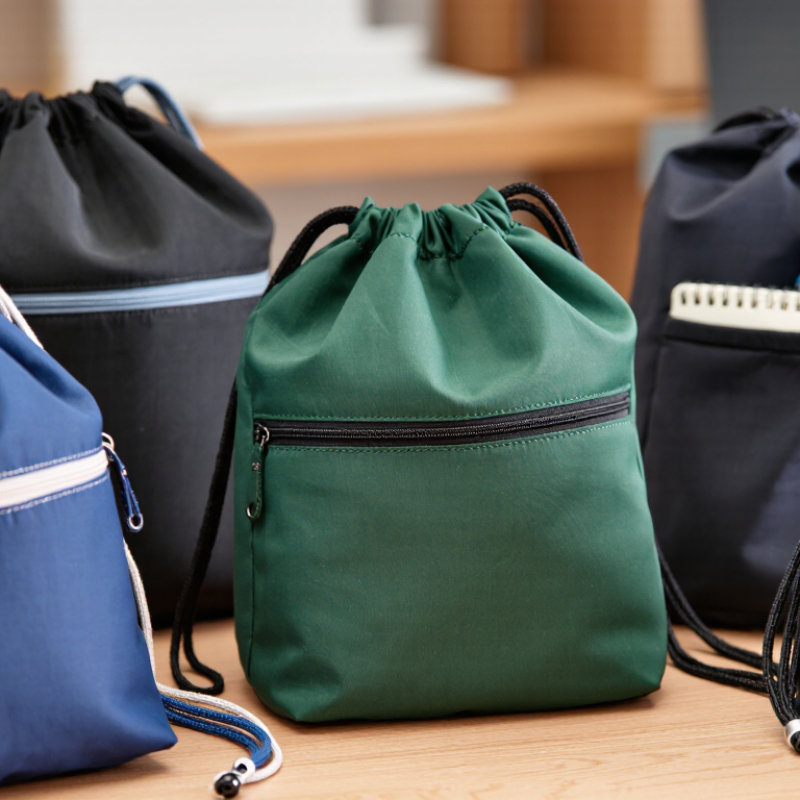
Drawstring Bag Types: Compare 190T Polyester, Cotton, and Nonwoven Options
For bulk orders, 190T polyester suits lightweight, compact bags with sharp printed graphics. Its smooth surface packs flat and dries quickly after light rain. Yet 190T describes fabric construction, not guaranteed strength. Ask for fabric weight, seam details, and a sample loaded with the intended contents. Check the seams. Cotton feels softer and more substantial, making it a better fit for shoppers who may reuse a bag often. It can wrinkle, absorb moisture, and vary in shrinkage unless treated. One point buyers often miss: fiber choice alone cannot predict service life.
Nonwoven bags, usually made from polypropylene, are often chosen for low-cost events and short-term distribution. They are light, but handles and seams may wear faster under repeated heavy loads. Textile Exchange’s Materials Market Report 2024 estimates that polyester made up 57% of global fiber production in 2023, compared with 20% for cotton. That is useful supply-chain context, not a durability rating for any bag. For a fair comparison, request samples in the exact construction, then test them with real items: a water bottle, catalog, or packed lunch. A small detail matters. Handle attachment can fail before the fabric does.
Best Drawstring Bag Materials for Bulk Buyers in 2026
Typical fabric-weight ranges help compare material options. Lower GSM means lighter fabric; actual specifications vary by supplier and construction.
190T is a fabric thread-count designation, not a GSM value. The ranges shown are indicative examples, not universal standards; confirm the exact fabric weight and construction when requesting bulk quotes.
Capacity and Load Fit: Match Dimensions and GSM to the Intended Contents
For bulk orders, size the bag around the actual item, not a guessed “standard” capacity. A 35 × 40 cm flat bag suits a folded T-shirt or a few small giveaways; boxed items usually need a gusset. Measure the packed contents, then allow roughly 3–5 cm of clearance so seams do not strain when the bag is filled. That matters. A tall bag can look roomy yet still fail when a wide carton reaches the opening.
GSM is fabric mass per square metre, not a load rating. Around 120–140 GSM often works for light event handouts; 180–220 GSM offers a sturdier feel for books or heavier merchandise. These are starting ranges, not guarantees. Handle stitching, drawcord width, fabric weave, and seam reinforcement also affect performance. Test real loads. A simple pilot with the heaviest intended contents can expose cord slippage or seam distortion before production.
Material choice also deserves scrutiny. Textile Exchange’s Materials Market Report 2024 estimates global fibre production reached 124 million tonnes in 2023, up from 116 million tonnes in 2022. That scale makes clear specifications more useful than vague “eco” claims. Still, GSM alone cannot predict service life. Record bag dimensions, fabric weight, contents, and test results together; revise the specification if the sample sags or feels awkward to carry.
Durability Checks: Assess Seam Strength Using ISO 13935-2
For bulk buyers, seam failure can turn a useful drawstring bag into a costly return. Check the sewn areas that carry load, especially the cord channel and side seams. ISO 13935-2 provides a grab test for measuring the maximum force required to rupture a fabric seam. It offers a repeatable way to compare samples, not a guarantee that every bag will perform well in use.
Ask an independent textile laboratory to test specimens taken from representative production bags. The current standard specifies how specimens are prepared and tested, so avoid comparing results from different methods as if they were equivalent. Record the seam location, fabric, stitching, test direction, and peak force. Test several samples; one strong result proves little. Small details matter. A lab result may not reflect repeated pulling, abrasion, or wet use, so pair seam testing with practical checks on finished bags. That extra step takes time, but it can reveal weaknesses the test alone misses.
Recycled-Content Claims: Verify GRS’s 50% Minimum for Product Labelling
For bulk buyers, a recycled-content claim needs more than a supplier’s product sheet. The Global Recycled Standard (GRS) requires at least 50% recycled content for a product to carry a GRS label. Ask for a valid scope certificate and product-specific transaction documents, then check which parts count: the fabric, drawcord, stitching, or all three. A bag made with recycled fabric may still contain conventional cords. Details matter.
Textile Exchange’s Materials Market Report 2024 estimates that recycled polyester made up 12.5% of global polyester production in 2023, down from 13.6% in 2022. That shift makes clear sourcing records especially useful when comparing large orders. Check the stated recycled percentage by product weight, not just the recycled share of the fabric. Also request a sample and inspect the seams, cord ends, and print area; a verified claim does not guarantee a durable bag. A small but important distinction.
Tips: Match certificate scope to the exact bag and order. Keep claim documents with your purchasing records. If a supplier’s wording feels vague, ask for the percentage in writing.
Bulk Supplier Evaluation: Compare MOQ, Unit Cost, Lead Time, and Quality Control
Bulk buying drawstring bags is not just a search for the lowest unit price. Start with a written specification: bag dimensions, fabric weight, cord type, print method, and packaging. Without those details, supplier quotes may describe different products. A low price can hide thinner fabric or weaker stitching.
Compare minimum order quantities against realistic demand. A large MOQ may reduce the unit cost, but it can leave you storing bags for months. Ask whether the quoted price includes printing, sample fees, packing, and shipping. Request a cost breakdown. Small details count. For repeat orders, confirm whether the supplier can hold the same material and color; “close enough” can be noticeable across event kits.
Lead time should include sampling, production, inspection, and transit, not just factory days. Ask for a dated schedule and a clear update point if production slips. For quality control, request a pre-production sample and agree on measurable checks, such as dimensions, print placement, and seam strength. Photos help, but they cannot show every defect. A random inspection before shipment adds confidence, though it may not catch everything. No checklist is perfect. Review returned or damaged bags after delivery, then adjust the next order’s specifications.