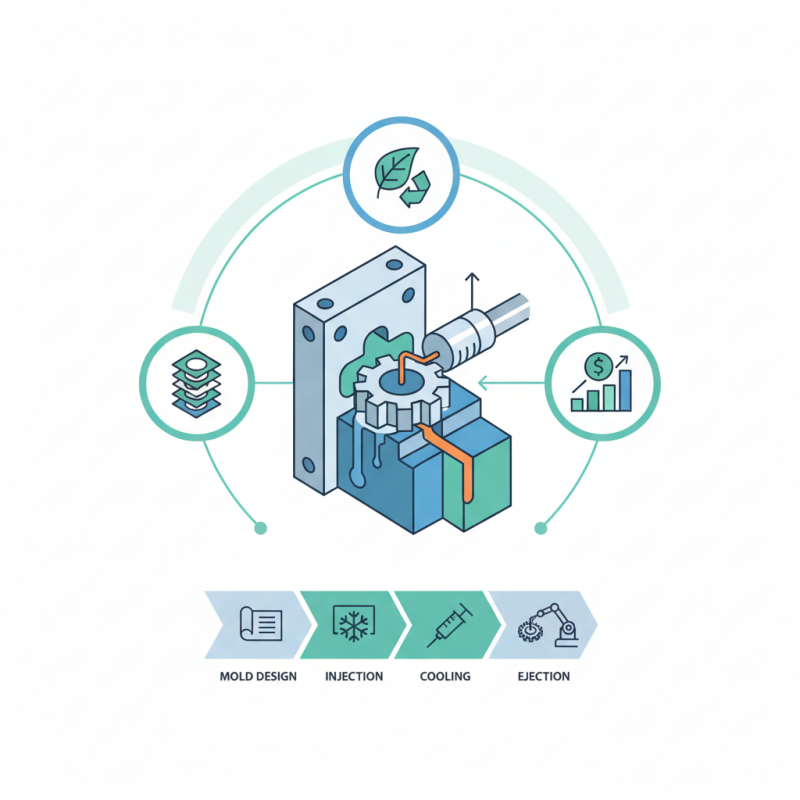
What is Plastic Injection Mold and How Does it Work?
The world of manufacturing has been transformed by the Plastic Injection Mold process. This method has become a cornerstone of various industries, with a market size expected to reach $34 billion by 2026. Plastic Injection Molds are essential in producing complex parts rapidly and efficiently.
Companies are increasingly seeking innovative solutions to meet rising production demands. Plastic Injection Mold technology allows for high precision and repeatability. Despite its advantages, the industry still faces challenges, such as the environmental impact of plastic waste. Recent reports highlight the need for sustainable practices in mold production.
Understanding Plastic Injection Molds is vital for manufacturers aiming to improve processes. The efficiency of this method is impressive, yet it requires ongoing evaluation and adaptation. As businesses embrace this technology, reflections on its impact will shape future advancements.
What is Plastic Injection Molding?
Plastic injection molding is a manufacturing process that creates plastic objects by injecting molten plastic into a mold. This technique is widely used due to its efficiency and precision. The process begins with heating plastic pellets until they melt. The molten plastic is then injected into a mold cavity, where it cools and solidifies. This method enables the production of intricate shapes and designs not easily achievable with traditional manufacturing.
One notable advantage of plastic injection molding is its ability to produce large quantities with high consistency. However, it requires significant upfront investment in mold design and construction. Each mold can be costly and may need modifications after initial production runs. Some manufacturers overlook the importance of testing prototypes, risking errors in mass production. A well-designed mold can lead to efficiency, while a poorly made one can lead to delays and increased costs. Fine-tuning the process for specific applications is essential but often neglected.
History and Evolution of Injection Molding Technology
The history of injection molding dates back to the early 19th century. In 1872, a man named John Wesley Hyatt patented a method for molding items from celluloid. This innovation laid the groundwork for future developments. Although it was rudimentary, it set the stage for what we know today as plastic injection molding.
As technology progressed, the 1940s saw the introduction of thermoplastics. These new materials revolutionized the industry. Companies began experimenting with new forms and shapes. However, many faced challenges with quality and efficiency. Early machines were often slow and unreliable, leading to a steep learning curve for manufacturers.
By the 1980s, technology had advanced significantly. Automated machines made the process quicker and more precise. Nonetheless, not every advancement proved beneficial. Some new techniques were difficult to master or expensive to implement. The evolution of injection molding reflects both great strides and persistent obstacles, highlighting the complexity of balancing innovation and practicality.
Key Components of Plastic Injection Molds
Plastic injection molds are essential in manufacturing. They consist of several key components that work together to create intricate plastic parts. A mold typically includes a cavity, where the melted plastic is injected, and a core, which forms the internal shape. These sections fit tightly to prevent leakage during the injection process.
The cooling channels are another crucial part. They allow a coolant to flow, helping the plastic solidify faster. This speeds up production time, which is vital in manufacturing. However, designing efficient cooling systems can be challenging. If poorly engineered, this can lead to uneven cooling, causing defects in the final product.
Ejector pins also play a significant role. They push the finished part from the mold once it has cooled. If these pins are misaligned, they can leave marks on the product. Additionally, the mold's material itself is crucial. Different materials have different durability. Some might wear out faster, leaving manufacturers with constant repairs. This can be frustrating and costly.
The Injection Molding Process: Step-by-Step
The injection molding process transforms plastic pellets into usable products through a series of steps. It begins with the melting of plastic in a heated barrel. The melted material is then injected into a mold under high pressure. This allows the plastic to take the shape of the mold cavity. After cooling, the mold opens, and the finished product is ejected.
Every step requires careful attention. Too much heat can degrade the plastic. Inadequate pressure may result in incomplete molds. It’s essential to monitor temperature and pressure closely.
**Tip:** Keep mold maintenance in mind. Regular cleaning prevents buildup of materials that can cause defects.
Once the product is ejected, any excess plastic must be trimmed. This is known as flash. Adequate trimming ensures a clean finish. Also, it prevents potential issues in future uses.
**Tip:** Consider running small batch tests. They help identify problems before mass production. A little adjustment can improve quality significantly.
Plastic Injection Molding Process Overview
This chart represents the time required for each step in the plastic injection molding process. Starting from material preparation, followed by injection, cooling, ejection, and finally finishing. Understanding this breakdown helps in optimizing production efficiency.
Applications and Advantages of Plastic Injection Molding
Plastic injection molding is widely used across various industries. This technique allows manufacturers to create complex shapes and designs efficiently. It’s a favorite in automotive, consumer electronics, and healthcare sectors. The process involves melting plastic pellets and injecting them into a mold. Upon cooling, the plastic solidifies, forming the final product.
One major advantage of plastic injection molding is its ability to produce high volumes quickly. It reduces waste and ensures consistency in the finished items. However, the initial setup costs can be high. It requires precise machinery and skilled operators. Some might overlook the need for regular maintenance, which can lead to inefficiencies.
Moreover, the design phase is critical. A poorly designed mold can result in defective products. Engineers need to collaborate closely during this stage. Despite its advantages, not every project is suitable for this method. Certain designs may require more manual craftsmanship, which can be more adaptable for unique items. Balancing speed, cost, and quality often poses a challenge for manufacturers.
What is Plastic Injection Mold and How Does it Work? - Applications and Advantages of Plastic Injection Molding
| Feature | Description | Advantages |
| Material Types | Thermoplastics, Thermosetting plastics | Wide range of materials suitable for various applications |
| Process Cycle Time | Typically ranges from 15 seconds to 2 minutes per cycle | High efficiency and fast production |
| Mold Design | Custom molds tailored to product specifications | Highly precise and complex shapes can be achieved |
| Applications | Automotive parts, consumer products, medical devices | Versatile usage across various industries |
| Cost Efficiency | Reduced material waste and lower production costs | Cost-effective for mass production |