
Top 10 Food Bucket Types for Global Buyers
Choosing a food bucket involves more than checking volume and price. Buyers must examine food-contact materials, lid security, stacking strength, filling temperature, and transport conditions. A five-gallon bucket may look suitable, yet its handle can fail under repeated warehouse use. Small details matter.
Dr. Susan Selke, a respected packaging researcher and author, has described packaging as “a system, not just a container.” This view is useful when comparing polypropylene, HDPE, molded fiber, and reusable food bucket designs. Each material behaves differently around moisture, heat, impact, and recycling systems. Regional requirements also vary, so buyers should verify current food-contact standards with qualified local specialists. A supplier’s test reports, factory audits, and traceable production records can reveal more than attractive product photos.
This guide reviews ten practical food bucket types for global purchasing teams. It considers round pails, square buckets, tamper-evident designs, stackable models, airtight containers, freezer-ready options, and large-volume formats. The comparison focuses on real use: filling lines, warehouse shelves, delivery trucks, and restaurant storage rooms. Some choices seem obvious. They are not always right. A lightweight bucket may reduce shipping costs but feel weak during daily handling. A thicker wall may improve durability but increase material use and freight weight. The best decision depends on the food, supply chain, market, and end-user habits. No single bucket wins everywhere.
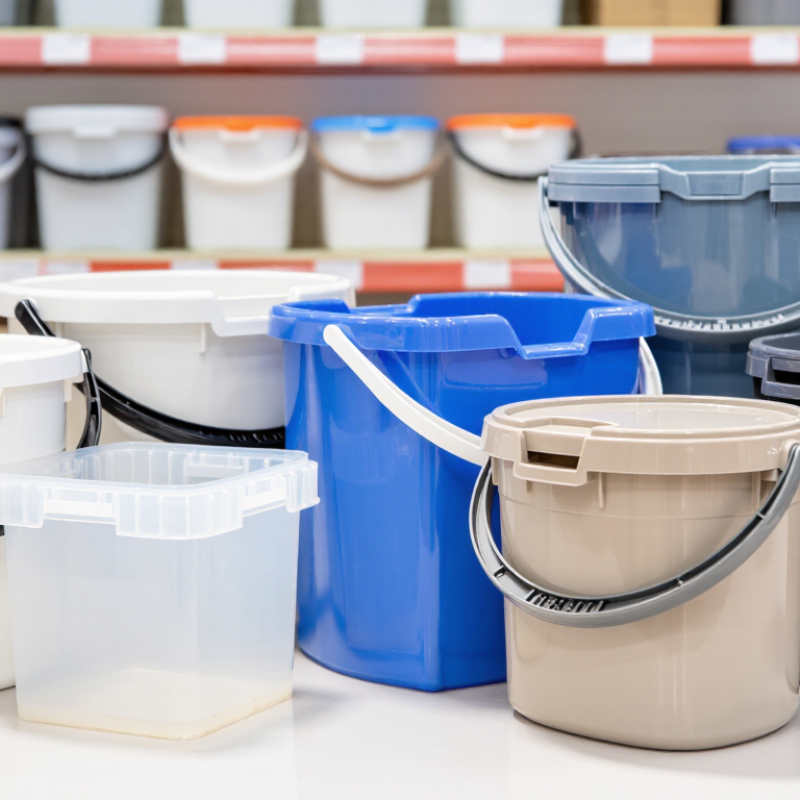
Top 10 Food Bucket Types for Global Buyers
Food Bucket Basics: Materials, Sizes, and Typical Uses
Food buckets usually use food-grade HDPE or polypropylene. These plastics resist moisture, impact, and many common ingredients. HDPE suits flour, grains, sauces, and powdered foods. Polypropylene performs better with warmer filling conditions. However, temperature limits must come from testing, not assumptions.
Common bucket types include pails with snap-on lids, tamper-evident buckets, screw-top buckets, and airtight containers. Stackable designs save warehouse space. Buckets with metal handles work well for heavier contents. Smaller 1 to 5 liter sizes fit spices, toppings, and household portions. Medium 10 to 20 liter buckets suit bakeries and food-service kitchens. Larger 25 liter and 30 liter sizes support bulk ingredients. Bigger is not always better. Full buckets become difficult to lift safely.
Material choice depends on the food, filling temperature, transport route, and storage period. A clear bucket helps users inspect contents, while an opaque one protects light-sensitive ingredients. Stainless steel offers strong durability and easy cleaning, but it costs more. Some metal buckets may dent or react with acidic foods. Check food-contact compliance for the destination market. Ask for migration test reports, closure details, and cleaning guidance. In practical sourcing, lid fit causes more problems than buyers expect. A sample test under real warehouse conditions can reveal weak handles, warped rims, or poor seals. I would not approve a large order without it.
Food buckets serve different products, climates, and distribution routes. The ten main types include standard plastic buckets, airtight buckets, tamper-evident buckets, stackable buckets, pail-in-pail systems, metal food tins, paperboard buckets, reusable transport buckets, freezer-safe buckets, and buckets made with recycled content. Each type creates a different balance between protection, cost, and handling efficiency.
Standard plastic buckets suit flour, sauces, pickles, and dry ingredients. Airtight designs help protect powders from humidity. Tamper-evident lids support safer retail distribution. Stackable shapes save warehouse space, especially on mixed pallets. Freezer-safe buckets must resist cracking below zero. Metal containers tolerate heat better, but they may dent during long-distance shipping. Paperboard options can reduce material use, although moisture remains a serious weakness.
Experienced buyers should check food-contact compliance, lid security, wall thickness, and temperature limits before comparing prices. Testing should include drop resistance and leakage after transport. A five-kilogram bucket may look efficient until its handle fails in a cold warehouse. Small details matter. Recycled-content buckets can support sustainability goals, but odor and consistency require careful inspection. No bucket wins every market. Regional rules also differ, so certificates should be verified locally rather than assumed. In practice, the cheapest container is not always the most reliable choice.
Food-grade safety standards vary across international markets. A bucket approved for one region may need additional documentation elsewhere. Buyers should check the material, intended food use, temperature range, and filling conditions.
Common options include round HDPE buckets, square HDPE buckets, polypropylene buckets, stackable buckets, tamper-evident buckets, airtight buckets, lined buckets, nesting buckets, measuring buckets, and wide-mouth storage buckets. Each type serves a different supply need.
Dry ingredients often require strong walls and secure lids. Oils and sauces demand better sealing and chemical resistance. Frozen foods need plastics that remain stable at low temperatures.
Material alone does not prove safety. Request food-contact declarations, migration test results, production-lot traceability, and cleaning records. Confirm compliance with the destination market’s rules, such as applicable European, North American, or national requirements. Recycled content also needs careful review. It may be acceptable for some uses but restricted for direct food contact.
In procurement audits, small details often create large risks. Ink placement matters. Lid friction matters. Odor matters. A clean-looking bucket can still fail a migration test. No checklist replaces supplier verification. I would inspect samples under real loading conditions, including stacking, transport vibration, and temperature changes. Documentation can be incomplete, too. That weakness deserves attention before the first shipment. Safety decisions should follow tested evidence, not attractive packaging or low prices.
Top 10 Food Bucket Types for Global Buyers
How to Choose the Right Bucket for Each Food Product
Food buckets are not interchangeable. A dry powder needs a different barrier than pickles or cooking oil. The FAO reported that 14% of food is lost between harvest and retail. Poor packaging can increase that risk through moisture, leakage, or contamination.
For flour, rice, and grains, choose stackable HDPE or PP buckets with tight lids. Round buckets suit liquids and sauces because they clean easily. Square buckets save warehouse space. Tamper-evident buckets help buyers identify unwanted opening. Airtight buckets protect coffee, spices, and powdered ingredients from humidity. Lined buckets can support products with strong aromas or sensitive oils. IML buckets improve label durability during cold storage. Recycled-content buckets may reduce material use, but food-contact suitability must be verified. Small portion buckets fit foodservice applications, while large pails support bulk ingredients.
UNEP’s Food Waste Index Report 2024 estimated 1.05 billion tonnes of food waste in 2022. A reliable seal cannot solve every supply-chain problem, but it can reduce exposure during handling. Check the food’s pH, fat content, temperature, filling method, and storage period before selecting plastic. FDA food-contact requirements, EU framework rules, and local import standards may differ. Ask for migration tests, closure torque data, and drop-test results. Do not trust a “food grade” claim alone. I have seen attractive buckets fail because their lids warped under heat. Specification sheets need real warehouse trials.
| No. | Bucket Type | Best Food Applications | Typical Capacity | Common Material | Key Food-Safety Features | Closure Options | Main Advantages | Important Selection Considerations |
|---|---|---|---|---|---|---|---|---|
| 1 | Standard Plastic Pail | Pickles, sauces, syrups, grains, flour, powdered ingredients and bulk snacks | 5–25 L | Food-contact polypropylene or high-density polyethylene | Food-contact grade resin, smooth interior, optional tamper evidence | Snap-on lid, tear-strip lid or lever-lock lid | Versatile, stackable, lightweight and widely available | Confirm compatibility with oil, acid, salt, solvents and the intended filling temperature |
| 2 | Airtight Screw-Top Bucket | Coffee, tea, cocoa, dry mixes, cereals, powdered milk and baking ingredients | 3–20 L | Polypropylene or high-density polyethylene with a gasketed lid | Replaceable gasket, low air exchange and protection from moisture ingress | Threaded screw lid with induction or peelable inner seal | Helps preserve aroma, freshness and powder flowability | Check gasket performance, lid torque and whether the product needs oxygen or moisture barriers |
| 3 | Tamper-Evident Bucket | Retail sauces, spreads, nutritional powders, confectionery and ready-to-eat foods | 1–20 L | Food-grade polypropylene or high-density polyethylene | Breakaway ring, tear strip or integrated tamper-indicating seal | Snap lid with tear band or security ring | Clearly communicates package integrity during distribution | Select a seal that is difficult to remove accidentally but practical for the consumer to open |
| 4 | Metal Pail | Cooking oils, fats, sauces, syrups and high-volume food ingredients | 5–25 L | Tin-plated steel or coated steel suitable for food contact | Internal coating can reduce product-to-metal contact and corrosion risk | Lever-lock lid, crimped lid or screw closure | High rigidity, strong stacking performance and good light protection | Verify coating compatibility with acidic or salty foods and protect against dents and rust |
| 5 | Insulated Food Bucket | Frozen foods, chilled ingredients, ice cream, dairy products and prepared meals | 5–30 L | Double-wall polypropylene, expanded foam or vacuum-insulated construction | Food-contact inner liner, thermal insulation and leak-resistant closure | Gasketed snap lid or screw lid | Slows temperature change during short-distance handling and delivery | It does not replace validated cold-chain control; test thermal performance for the actual route |
| 6 | Fermentation Bucket | Kimchi, sauerkraut, fermented vegetables, brines and cultured food products | 10–30 L | Food-grade polypropylene or high-density polyethylene | Acid- and salt-resistant surface, smooth cleanable walls and optional airlock | Gasketed lid, airlock lid or weighted fermentation cover | Supports controlled fermentation and convenient batch handling | Allow for gas release; avoid airtight sealing unless the design includes pressure control |
| 7 | Ingredient Storage Bucket | Flour, rice, sugar, grains, legumes, spices and dry baking ingredients | 10–60 L | Food-grade polypropylene or high-density polyethylene | Moisture-resistant body, cleanable interior and pest-reducing lid design | Gasketed lid, hinged lid or snap-on lid | Good for warehouse organization, repeated opening and bulk dispensing | Use a capacity that leaves enough headspace for safe lifting and select lids that limit humidity entry |
| 8 | Pouring-Spout Bucket | Liquid oils, sauces, dressings, syrups and food-service concentrates | 5–20 L | Food-contact polypropylene or high-density polyethylene | Leak-resistant spout, compatible gasket and smooth drainage area | Screw cap, flip-top spout or sealed dispensing closure | Improves controlled pouring and reduces product waste during use | Match spout size and viscosity performance to the product; verify drip control and closure re-sealing |
| 9 | Collapsible Bucket | Dry snacks, produce, bakery ingredients and returnable food-service transport | 5–25 L | Flexible food-grade polypropylene or multilayer plastic construction | Cleanable food-contact liner, reinforced seams and optional sealed cover | Fold-over lid, zip closure or snap lid | Reduces empty-return volume and storage space requirements | Check load-bearing strength, seam hygiene, puncture resistance and suitability for repeated washing |
| 10 | Reusable Stackable Bucket | Food-service ingredients, sauces, grains, dry goods and institutional catering supplies | 10–30 L | High-density polyethylene or polypropylene with reinforced walls | Durable food-contact surface, washable design and traceability area | Gasketed snap lid, hinged lid or lever-lock lid | Efficient use of warehouse and transport space with multiple-use potential | Establish a cleaning, inspection and replacement procedure to prevent cross-contamination |
Global food buyers usually compare more than price. They assess material safety, filling temperature, shelf life, and shipping strength. Common choices include polypropylene pails, HDPE buckets, metal tins, lined paperboard buckets, fiber buckets, airtight containers, stackable pails, handled buckets, clear buckets, and tamper-evident designs. Each type suits different products, from sauces and grains to powdered ingredients.
Sourcing should begin with documented food-contact compliance and consistent production records. Ask for wall thickness, lid fit, handle load, carton dimensions, and test samples. Customization may include color, molded volume marks, labels, embossing, and printed lids. However, complex artwork can increase lead times and minimum order quantities.
A mistake I still see is approving appearance before checking pallet stability. A beautiful bucket is useless if its lid pops open during transit.
Request samples from every proposed factory. Test stacking with filled buckets. Confirm incoterms, port handling, moisture protection, and container loading plans. Leave space for seasonal delays. Shipping costs can change sharply when a bucket design adds only a few centimeters. Nested empty pails may reduce volume, but rigid handles can prevent efficient packing. Buyers should also inspect batch codes and closure performance before mass production. Not every specification will survive real handling. Recheck it.
CONTACT US
|
